Parts of some whole
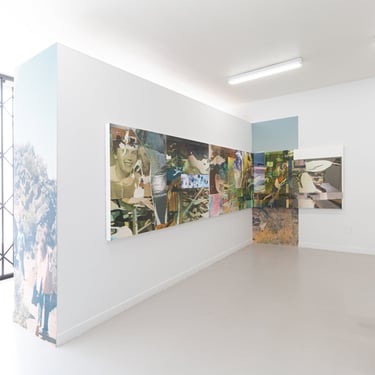
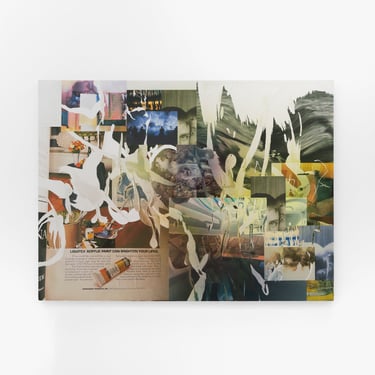
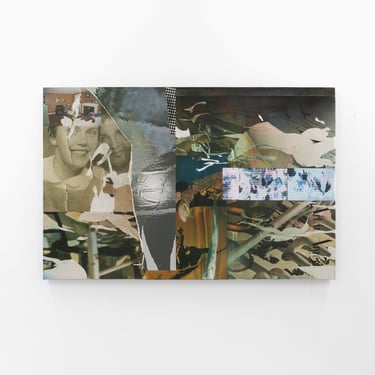
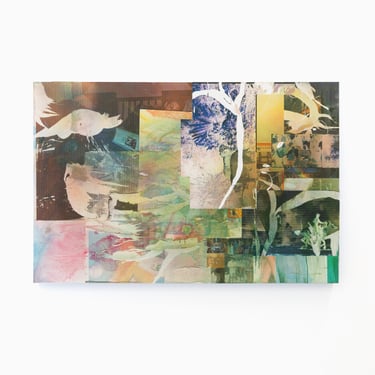
Stowaway is pleased to present 'Parts of some whole', a solo exhibition by Los Angeles-based Jackson Hunt. Hunt presents 5 paintings installed in 2 parts. Please join us for an artist reception April 4th, 2026, from 5 –8 pm.
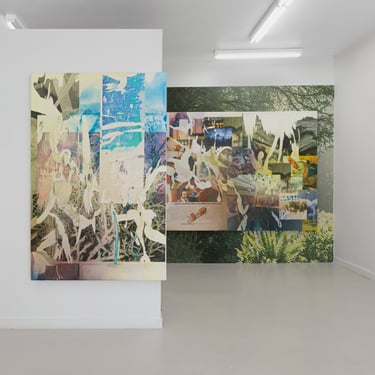
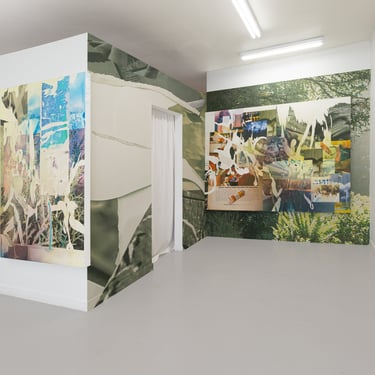
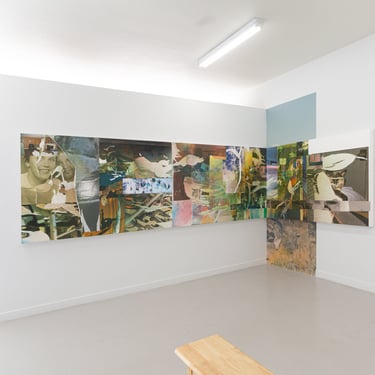
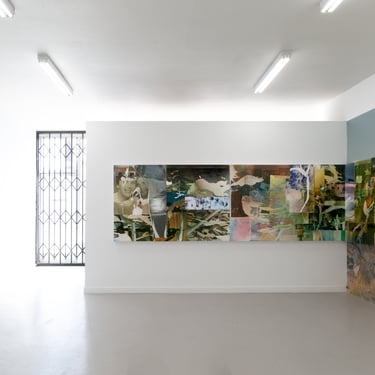
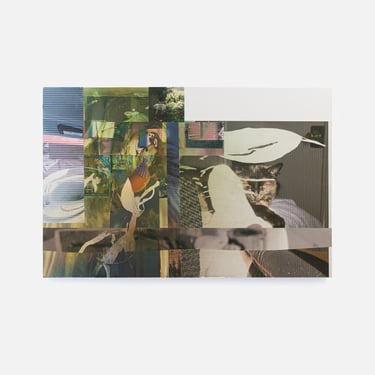
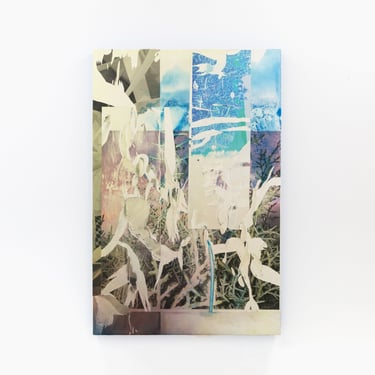
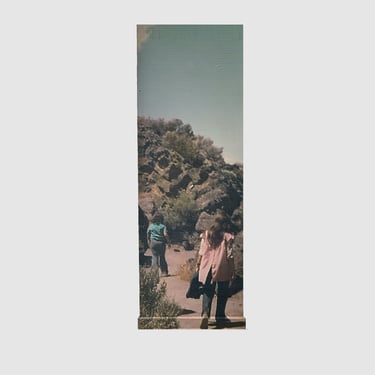
Parts of some whole includes five paintings which form two sets. One is a triptych of horizontally oriented panels hinged across the front corner of the gallery space. The other is a displaced diptych, with a larger panel centered on the recessed wall at the back of the gallery, and a second smaller panel slightly overhanging the edge of the parallel wall in the main portion of the gallery. Both sets of panels are partially backed by sections of textured vinyl wallpaper, which Hunt has printed with hyper-enlarged images selected from the set of photographs that form the material and ground of his paintings.
He works with an inherited large format printer whose age and disuse has caused a range of miscalibrations that result in color distortions and banding reminiscent of the field distortions of well worn analog video. These bands recur in patches across the surfaces of the paintings, sometimes reoriented vertically or inverted, so that the entire experience of space in the exhibition seems at times to vibrate under the same prismatic iridescence. This sense of hazy continuity is offset by the stark assertion of edges and angles in the installation as well as in the paintings, so that pockets of intense flatness and vertiginous depth seem to slide against each other, puncturing and punctuating space, sometimes serrating it to the point of becoming rhythmic.
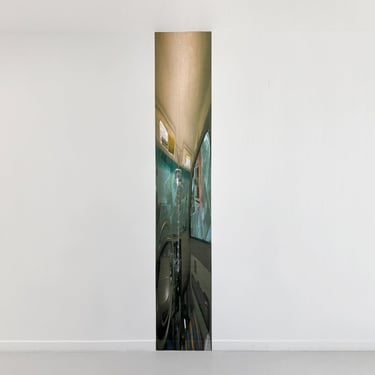
The displaced diptych produces an almost stereoscopic effect, as the smaller panel overhangs the wall paper print on the adjacent wall or the panel on the recessed back wall, shifting across the architecture like an accordion fold according to one's point of view. The wall paper which backs the third panel of the triptych at the front of the gallery has also been displaced in strips across two other parallel walls, one at the back of the gallery's front room, one in the threshold between this room and the main gallery space. Slightly offset from this, one last strip of wallpaper stretches a wide angle photograph taken from the inside of a car into a narrow column from floor to ceiling. The spatial displacements in the installation repeat a maneuver which is central to Hunt's painting practice, a game of edges and planes - torn, cut, layered, juxtaposed - so that one is at all points confronted with what is fundamentally the working and reworking of surfaces, even as one cannot help falling into their mysterious and hard wrought depths.
Despite his meticulous control over gestures of placement and displacement, the most gestural dimension of the works emerges from an act of surrender to the materiality of his processes. What appear to be deliberate gashes and streaks of white across the surfaces of the paintings begin as bubbles where the prints did not fully adhere to the surface. That nothing quite sticks, not all the way anyway; that things don't quite fit or sit; that everything accrues as marks on a surface, even erasures and excisions; these become the starting points for a series of gestures which resolve ultimately under the finely tuned reworking of a set of accidents, which remain variously raw or incorporated under skeins, mists, and smears of a opalescence.
Along with his inherited printer, Hunt also works with inherited images, family photographs, as well as fragments of mass cultural symbols like the Marlboro man, already filtered through Richard Prince's appropriations, or the cover of Art in America and Time Magazine. The most striking and strikingly photographic image in the show is a picture of two young women in the left panel of the triptych whose knowing and mischievous gazes capture us with a certainty that feels impossible to return. It is all the more striking an illusion because it is not us but themselves that they glimpse in the two way mirror of a photo booth. The young woman on the right is Hunt's grandmother. You wouldn't know it from looking at his earlier work, but for years most of it was constructed from a single photograph of his grandmother's desk, enlarged, reduced, fragmented, rephotographed, and layered upon layered, to the point of near total abstraction. Nested in that photograph was another photograph that she had collected of young women on horseback, all facing the camera, grinning widely as they raise their cowboy hats high. If there is an iconology in Hunt's practice its elusive center might be here.
The recent paintings have surfaced the photographic dimension of the work in a way which invites this kind of looking. One has the sense that the works are full of details whose legibility might reward recognition. They do, but the work also remains stubbornly, gorgeously, somewhat melancholically, absorbed in the material effects of its own processes, which are ultimately about the messy, belabored and beloved uncertainty of memory, about the ambiguity of a symbol and its content, and about the peculiarly personal and idiosyncratic ways in which we do and do not see ourselves.
--Edward Sterrett
Jackson Hunt (b. 1988) is an artist and educator based in Los Angeles. Hunt is a descendant of the Klamath and Modoc Tribes and is an enrolled member of the Cherokee Nation. Recent solo and group exhibitions include, "Some of All Parts" curated by Kim Garcia at the CCS Gallery at UC Santa Barbara, "Sizzler" curated by Grant Edward Tyler and hosted by Wilshire Online, and "Photorealism" curated by Ewa Słapa at Phase Gallery. Hunt was a resident at the Vermont Studio Center and his work has been featured in New American Paintings and recently published in The Living Commons Collective Magazine. He received his MFA from UC Irvine.